Outlining ... Done.


After ideation of the topics, themes, and main characters for my novel, which took me 22 hours, the second stage was outlining, on which I spent 32 hours of my time.

Think of outlining as creating a roadmap for your story.
Some writers love to plan every detail (we call them "plotters"), while others prefer to wing it (the "pantsers"). Me? I lean strongly toward plotting. I start by jotting down my main characters, their goals, and the obstacles they'll face. And then, I rough out all plot points. I don't worry about details or perfection–this is just my story's skeleton.
The result I have now is a long spreadsheet of 76 rows briefly describing chapters, scenes, POV, timing, and what happens in those scenes for most of the characters in the story.
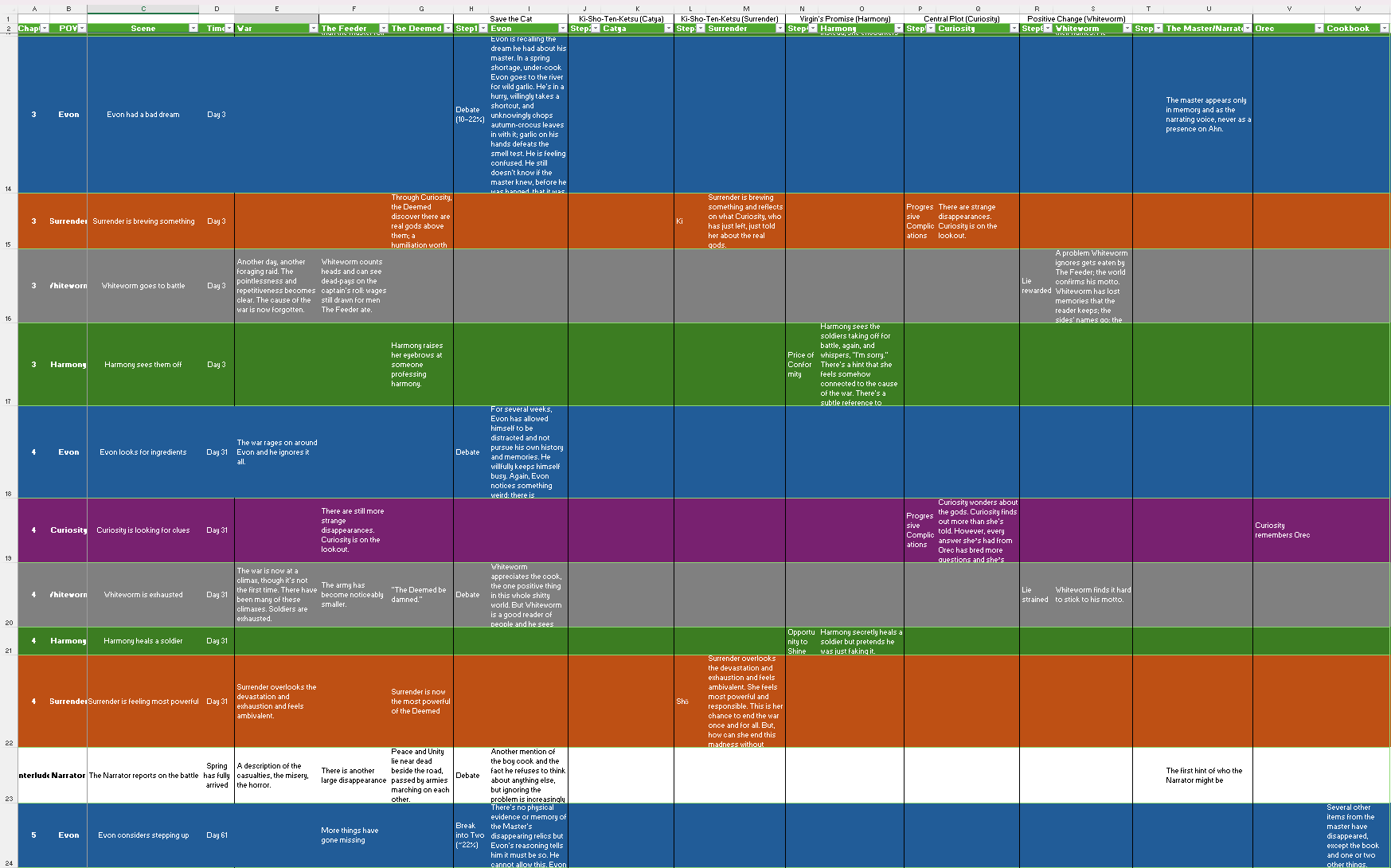
The fun part of this stage (for me) is that it's like creating and solving a puzzle: each character has an arc with multiple story beats. Each needs to get from A to B on their personal journey while they all influence and disrupt the arcs of each other. And everything must fit in less than a hundred scenes!
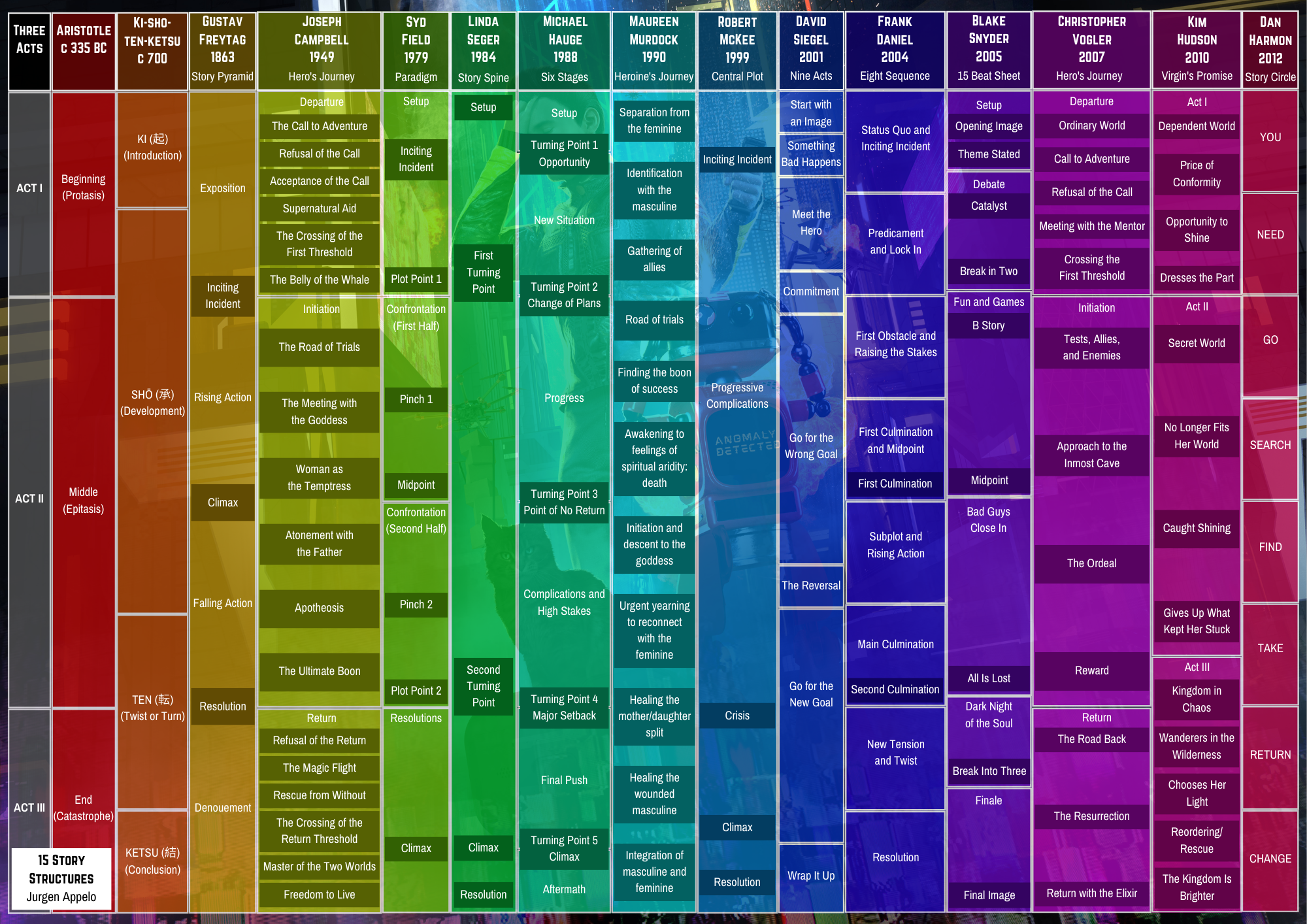
There are plenty of frameworks and storytelling templates to choose from, but picking the right one for each character can be quite a challenge.
Fortunately, Claude was of great help here.
I began by suggesting Snyder's Save the Cat framework for my main character Evon, and I asked Claude to suggest templates for the others. I disagreed with one of Claude's suggestions, and Claude matched the last character with a template I hadn't even heard of (Weiland's Positive Change).
Here's a summary of what we picked:
Evon — Save the Cat. This was your pick, not mine. You used it for Glitches of Gods and arrived with it. My contribution was the flipped polarity: a hero who is trying not to learn the lesson, so Snyder’s beats keep their positions but reverse their charge, and the darkest beat is the one where his life looks most comfortable. Fifteen beats, because he is the only character carrying the whole book.
Catya — Ki-shō-ten-ketsu. She serves, notices, discovers, leaves, watches. No antagonist, no plan, no victory. Any Western column would hand her a want, an obstacle, and a climax, and you’d have invented a fight for a woman on the serenity side of the book. KSTK’s shape (introduction, development, a turn that makes you reread everything before it, a settled ending) is the shape of an acceptance arc: nothing gets defeated, something gets understood.
Harmony — Hudson’s Virgin’s Promise. The only framework whose subject is a true self hidden inside a world that depends on her playing a minor role, and the world reorganising when the self is shown. I didn’t go looking for it; her beats were already sitting in Hudson’s slots before anyone named them. Her ending inverts Hudson’s, which is exactly where a book should differ from the textbook.
Surrender — Ki-shō-ten-ketsu again. Almost no stage before the siege, no quest, nothing to fight; she holds. Reusing Catya’s shape was the point, not laziness: two turns, in the same castle, closing at the same dawn, with opposite outcomes. A second framework would have hidden that pairing.
Curiosity — McKee’s Central Plot. Here the record needs straightening. I originally proposed Harmon’s Story Circle. You pointed out that eight mandatory stages means at least eight scenes for a character who might deserve no more than five, and you suggested McKee or Seger. I chose McKee, and not for the count. Both are five beats, but Seger’s turning points are events, while McKee’s Crisis is a dilemma, a choice where every option costs. Curiosity’s arc is exactly that. Seger has no slot for it; McKee has one with its name on it.
Whiteworm — Weiland’s Positive Change Arc. When I then read his scenes in your sheet, the arc was already there and nobody had labelled it: a man with a motto, a world that keeps proving the motto right, and a man who gives it up anyway. Weiland’s Lie-and-Truth is exactly that: the lightest template that still produces change: six beats, no quest, no mentor, no villain.
After identifying the template for each character, it was up to me to fill the spreadsheet and write out the scenes in a way that satisfied all frameworks. This was fun: sometimes, a scene that will be told from the point-of-view of character A actually ticks off a beat in the template for character B. Some scenes do double duty by carrying the momentum for multiple characters simultaneously. And in a few cases, nothing happens except that I intentionally drag out a tension that's already there.
Claude repeatedly reviewed the outcome of my creativity and told me where I hadn't nailed the beats yet:
“The shō is a routine, not a development. Going with the flow, mending, flirting, leaving the dead: those are states, and they describe her at 27% as well as at 69%. What develops in her over 43% of the novel?”
“Either works. The sheet has neither.” — the sentence that ends most of my critiques: two legitimate options, and I refuse to pick for you.
“Give scene B046 an event, something undeniable at 50%, because a twist without a scene is a footnote.”
“Start with the ketsu. It is the only cell with nothing in it, and it decides what the wall means.”
“Dawn 1 needs a lever. ... What does she do to be named out loud by a few more people before nightfall? That’s a decision; I know you already have options.”
And on and on it went...
Could I have done this without Claude? Probably, yes. But it would have likely cost me something closer to 320 hours rather than the 32 it took me now.
In Claude's words:
The pattern was: name the broken beat, say why, lay out the fork, refuse to choose. You did the choosing every time, including the times you chose neither branch. Second, if you want a number instead of a claim, the test harness logs provenance: of roughly 135 outline beats, two carry my wording. The rest are yours.
Now, I can move forward to the drafting stage.
Jurgen